Shop & equipment
Probably Stolen machines: modules, power and containers
Before the next overnight cycle, check a machine’s battery, required input and output space. For a water business, a Moisture Farm makes source water and a Water Purifier treats a loaded container. Quality, Performance and Efficiency solve different constraints; buy the module for the constraint you actually have.
A loaded machine still needs a complete setup
Case: a Water Purifier is owned but yesterday's bottle looks unchanged. Open the machine and check the Power Source slot, the Water Container slot and the module layout. Confirm the bottle actually contains water and the battery has usable charge. Keep the machine's running cost funded before ending the day.
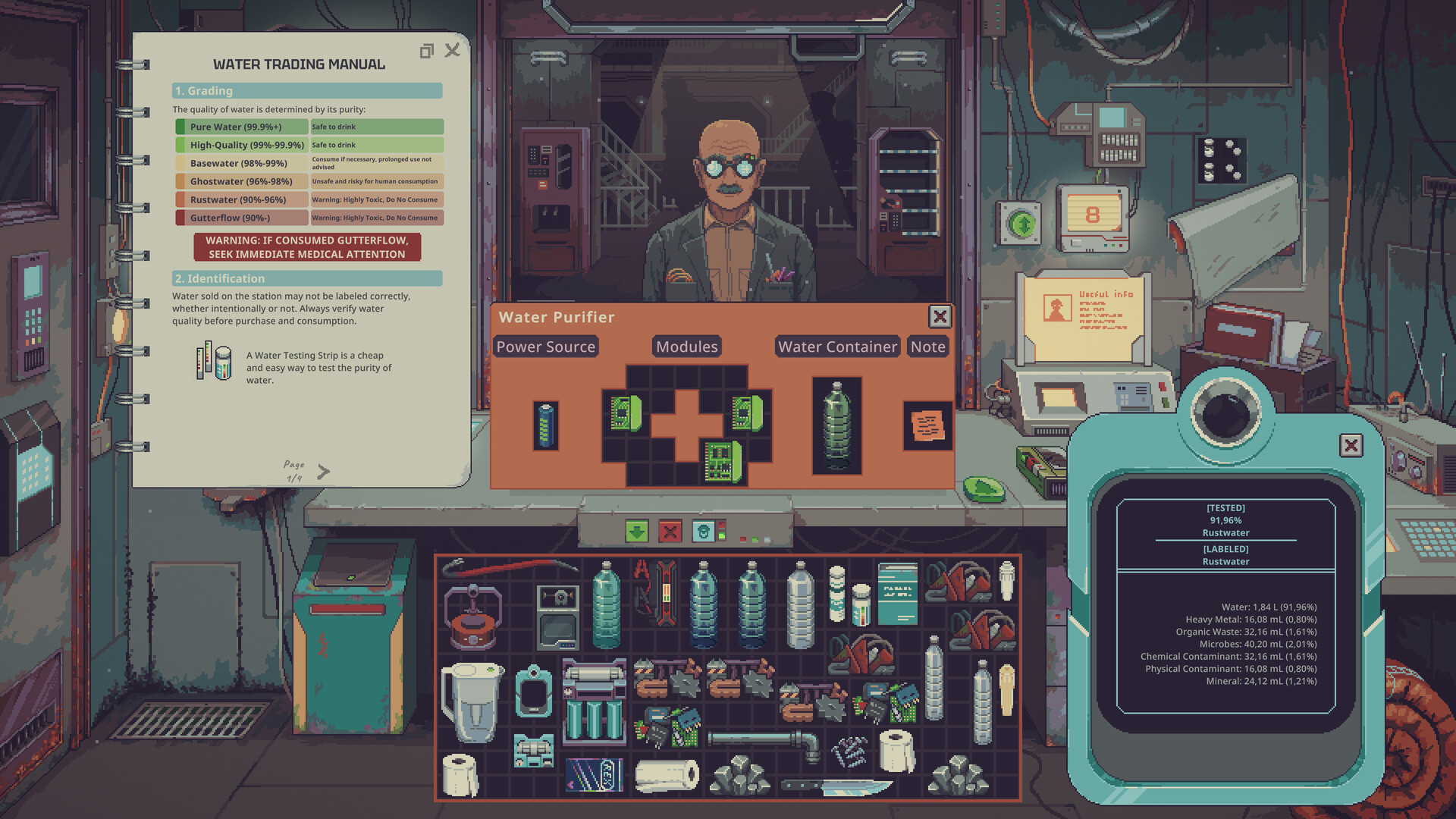
After the overnight cycle, compare the individual contaminant readings. No run points to power or loading; a run with no further purity gain can point to a treatment limit. Follow the purifier diagnosis before choosing the next purchase.
Make water, then prepare it for sale
A Moisture Farm needs usable charge and a loaded output vessel. Its basic community setup produces 1,000 ml of Ghostwater for 4 charge, while modules change its output and demand. Test the collected water and retain a vessel for the following night.
Use the Moisture Farm setup and module guide to choose between quality, volume, capacity and charge before expanding the line.
Choose the module from the bottleneck
| Machine / problem | What matters | What it does not solve |
|---|---|---|
| Moisture Farm: source water quality is too low | Quality affects the output grade in thresholds. | A small change below a threshold may not change the grade. |
| Moisture Farm: too little output for established sales | Performance affects produced volume. | No free container room, no power or unsold stock. |
| Water Purifier: running but unable to reach a cleaner endpoint | Quality changes its residual-contamination floor. | Performance alone is not a lower floor. |
| Water Purifier: useful cleaning takes too many cycles | Performance changes work per cycle. | It cannot make a limited configuration remove every final contaminant. |
| Working setup: energy cost is the constraint | Efficiency affects energy use in machine-specific steps. | An input, output or quality problem. |
Module effects are machine-specific. Read the machine's resulting stats after fitting a layout. Do not copy a percentage target or a layout from another machine just because the module fits. This guide deliberately avoids treating one historical threshold table as a universal upgrade formula.
Keep electricity and battery charging distinct
The Recharger charges batteries inside its inventory; the PowerBloc charges eligible touching batteries and machines, with the Recharger excluded. Both depend on paid power. Check the actual charge gain after the night before buying more equipment.
The charging and extra-run guide covers the 3/6 and 2/4 nightly rates, placement checks, power-service changes and the Turbo tool’s separate costs.
Containers and aging machines have different jobs
A Bottle Printer produces empty 450 ml, 750 ml or 2 L water bottles, depending on its upgrades. The container and printing guide covers the 3-part then 6-part upgrades and each size’s charge cost. Buy capacity for the batch you can actually sell.
An AgeWell acts on completed wine, adding aging during the night. It does not accelerate fermentation. If the unfinished wine bottle is what holds your cash, an AgeWell is not the next useful purchase.
Keep the current loop simple: enough power, the correct container, usable input and somewhere for finished goods. Expand only after those requirements and the next bill are already covered.